

How can PESTEL and the Triple Helix III models support your business in improving performance, re-branding, and achieving the organisation’s vision, mission, and objectives? Rebranding relies on future decision-making. Presently, many companies have successfully aligned their vision, mission, and goals with core values. The pandemic and various external and internal factors have necessitated adaptation of business goals to address the needs and challenges of society and the environment, particularly concerning climate change.
The PESTEL analytical tool is considered one of the most effective instruments for identifying and analyzing external factors and forces. It enables accurate data measurement and analysis, ultimately facilitating the forecasting of future risks and opportunities.
Megatrends are currently reshaping what is considered the “new normal” due to the influence of external and internal factors and forces. We are witnessing the effects of climate change, unpredictable weather patterns, and unprecedented events worldwide. These contemporary factors and forces have generated numerous risks and opportunities on a global scale.
Fortunately, many global companies have recognised their responsibility and have made significant changes to their business plans. Governments and wealthy nations no longer bear the burden of addressing the colossal force of climate change alone. Industries and companies are taking action to address global climate challenges through sustainability practices and ethical values. What is particularly intriguing is that this shift is in alignment with the needs and concerns of the people. This presents a golden opportunity to meet the needs and solve the problems faced by individuals. As an example, what are your thoughts on Siemens’ new scenario?
From my perspective, there has been a re-framing of the initial question, shifting the focus towards understanding the needs of both people and the environment. It seems that people’s priorities have shifted towards desiring a safer planet and a more convenient and affordable shopping experience. Siemens’ sustainability framework sets a good example, with its focus on A) Decarbonisation, B) Ethics, C) Governance, D) Equity, and E) Employability.
How can Siemens enhance and sustain their performance in achieving their business objectives and upholding their values?
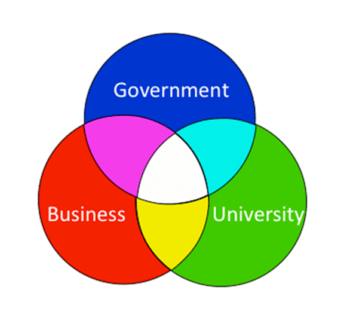
The Triple Helix-III model can aid in identifying the three key entities that can address the necessary needs and challenges. According to Triple Helix III, Academia, Industry, and Government can collaborate to create a sustainable competitive advantage in meeting the needs of both society and the environment. This model allows for the exploration of relationships between these entities and identifies areas for improvement in their interactions. It can serve as a valuable guide in achieving business objectives.
Reference:
Loet Leydesdorff and Henry Etzkowitz (1998) The TRIPLE HELIX as a Model for Innovation Studies, State University of New York. Science and Public Policy 1998. Available at: https://www.leydesdorff.net/th2/spp.htm (Accessed: 13 April 2019).
Triple Helix III Picture: https://pharmaceuticalintelligence.com/2014/07/29/a_primer_on_dna_and_dna_replication/
 MBA Blogger