
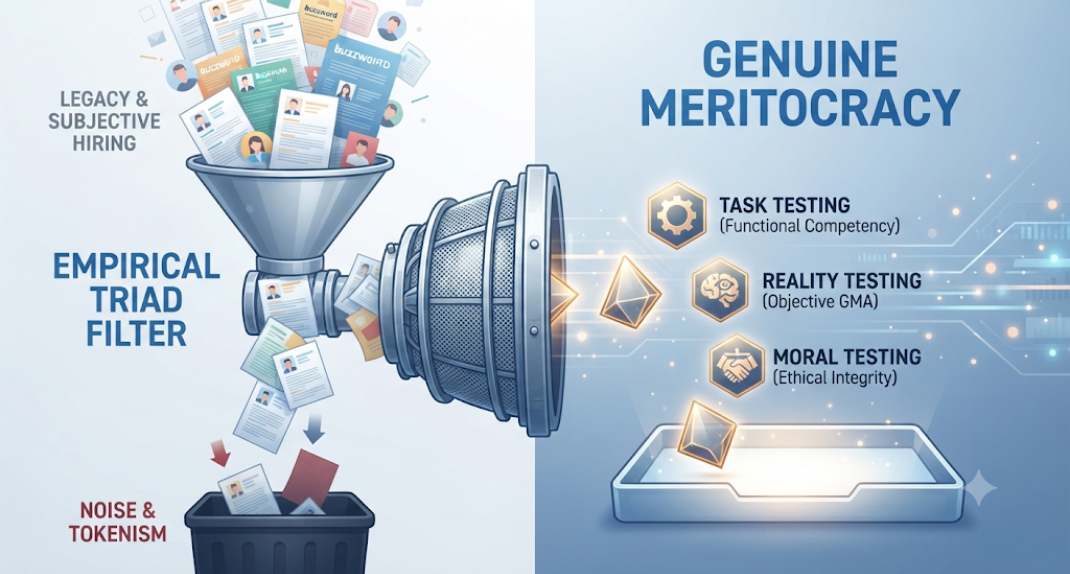
1. The Triad of True Meritocracy: Task, Reality, and Morality Testing
When objective, KSAO (knowledge, skills, ability, and other characteristics) frameworks and subjective, superficial DEI metrics, organisations break the three foundational pillars of effective talent acquisition to evaluate a candidate’s true competency and prevent organisational pathology, companies must shift from administrative checklists to three distinct empirical dimensions:
1. Task Testing (Functional Competency): This evaluates practical, domain-specific skills. According to industrial-organisational psychology, work sample tests are among the highest predictors of real-world job performance because they leave no room for narrative padding or demographic tokenism. You either can execute the task, or you cannot.
2. Reality Testing (Cognitive & Psychological Grounding): This assesses a candidate’s capacity to perceive objective facts and data over personal biases and self-delusion. High General Mental Ability (GMA) is deeply linked to strong reality testing. Candidates lacking this trait struggle to separate ideological performance or personal narcissism from business metrics, leading to flawed corporate decision-making.
3. Moral Testing (Ethical Integrity): This evaluates genuine accountability versus performative compliance. In a quota-driven system, opportunistic candidates easily pass the “subjective diversity test” by mirroring social buzzwords. True moral testing screens for core ethical alignment and merit-based collaborative values, rather than the ability to play political or agendical ‘agenda-driven’ games inside the corporate hierarchy.
2. Exposing the Deficiencies of Legacy KASO Frameworks and DEI Policies
The Mechanics of Tokenism: How Dysfunctional Recruitment Weaponises Subjectivity and Objectivity Within Workplaces
Tokenism does not occur in a vacuum; it is systematically engineered during the initial screening phase when organisations sacrifice empirical data for cosmetic compliance. Instead of genuinely integrating diverse perspectives or addressing systemic barriers, tokenism uses a small number of individuals as “tokens” to check a box or deflect accusations of discrimination.
Over-indexing on subjective corporate attributes creates an environment ripe for structural dysfunction. As sociologist Lauren Rivera (2012) demonstrated in her landmark study on elite firms, empty metrics like “culture matching” are easily hijacked by interviewers to select candidates based on personal chemistry rather than competence. When applied to a modern, forced DEI landscape, this cultural matching process effectively replaces rigorous skills sorting, leading to what can be described as a dangerous distortion of Reality Testing.
And later, policy makers injected the standard objective KSAO (Knowledge, Skills, Abilities, and Other characteristics like Experience) frameworks to the subjective DEI approach. However, rather than strictly measuring behavioral traits, many corporate talent acquisition processes still over-index on historical Experience and Credentials (pedigree). This reliance on arbitrary resume markers rather than verified competencies creates an entry point for corporate underperformance, as it fails to measure a candidate’s actual competency to execute the role, effectively blinding the organisation’s capability for rigorous Task Testing.
Modern HR departments often superficially apply DEI policies and routinely misapply objective KSAO frameworks by prioritising malleable credentials over verified cognitive and behavioral attributes. The empirical literature established by Schmidt and Hunter (1998) demonstrates that traditional recruitment metrics, such as years of education or job experience, possess remarkably low predictive validity (r = 0.10 and r = 0.18, respectively) for actual job performance. Instead, Task Testing (Work Samples) and Moral Testing (Integrity Tests) remain the gold standard for predicting occupational output. By over-indexing on arbitrary resume markers and ignoring rigorous objective and ethical integrity assessments, modern talent acquisition fails to measure an individual’s actual capacity. This systemic screening failure distorts Reality Testing and creates an entry point for Counterproductive Work Behaviors (CWB), allowing toxic actors to infiltrate the workplace and compromise both Moral Testing and Task Testing.
When recruitment dynamics displace empirical filters, the corporate ecosystem loses its moral and operational anchors, opening a direct entry point for Counterproductive Work Behaviors (CWB). Grounded in the extensive personnel selection literature established by Ones, Viswesvaran, and Schmidt (1993) on integrity testing, mitigating these institutional deficiencies requires replacing superficial resume filters with uncompromised, validated safeguards. To neutralise internal collusion and toxic actors, organisations must implement standardised integrity testing.
Furthermore, to bridge the gap between administrative compliance and operational truth, recruitment frameworks must employ standardised Situational Judgment Tests (SJTs) as a core mechanism of empirical Reality Testing. Although initially validated within high-stakes professional admissions—specifically dental student selection—research by Buyse and Lievens (2011) demonstrates that placing candidates within high-fidelity, job-related scenarios provides a robust, objective measure of actual capability.
Additionally, according to Choi et al. (2011), evaluating candidates based on their situational judgment effectiveness (SJE) provides a robust, objective measure of cognitive and behavioral alignment with complex workplace dynamics. Within this framework, SJTs serve as the primary empirical anchor for Reality Testing by forcing candidates to confront high-fidelity, job-related scenarios rather than allowing them to rely on static resume descriptions or superficial interviews. By assessing functional decision-making under realistic organisational constraints, this method successfully neutralises performative, ideological rhetoric and ensures that selected individuals possess the objective psychological grounding required to perceive empirical facts over personal biases.
Nonetheless, in practice each of these studies have failed, because each proposed solution lacks one or two of the proposed solution(s) by other researchers. So it could be argued that these three solutions need to be integrated in recruitment to sustain the organisational performance.
3. References:
Buyse, T., & Lievens, F. (2011). Situational judgment tests as a new tool for dental student selection. Journal of Dental Education, 75(6), 743–749. https://pubmed.ncbi.nlm.nih.gov/21642519/
Choi, D., Oh, I.-S., Guay, R. P., & Lee, E. (2011). Why do emotionally intelligent people have positive work attitudes? The mediating role of situational judgment effectiveness. International Journal of Selection and Assessment, 19(4), 352–362. https://doi.org/10.1111/j.1468-2389.2011.00564.x
Effron, D. A., & Monin, B. (2010). Letting people off the hook: When do good deeds excuse transgressions? Personality and Social Psychology Bulletin, 36(12), 1618–1634. [https://doi.org/10.1177/0146167210385922](https://doi.org/10.1177/0146167210385922)
Ones, D. S., Viswesvaran, C., & Schmidt, F. L. (1993). Comprehensive meta-analysis of integrity test validities: Findings and implications for personnel selection and job performance. Journal of Applied Psychology, 78(4), 679–703. https://doi.org/10.1037/0021-9010.78.4.679
Rhodes, C. (2021). Woke capitalism: How corporate morality is harming democracy. Bristol University Press. https://doi.org/10.51952/9781529211689
Rivera, L. A. (2012). Hiring as cultural matching: The case of elite professional service firms. American Sociological Review, 77(6), 999–1022. https://doi.org/10.1177/0003122412463213
Schmidt, F. L., & Hunter, J. E. (1998). The validity and utility of selection methods in personnel psychology: Practical and theoretical implications of 85 years of research findings. Psychological Bulletin, 124(2), 262–274. https://doi.org/10.1037/0033-2909.124.2.262
 MBA Blogger